
ASSAB: THE TREATY ENTITLEMENT OF ETHIOPIA TO THE RED SEA
Ethiopia’s Lack of Sea Access Is an Existential Threat
Ethiopia’s need to access the Red Sea has never been a mere question of economics or logistics. It is intimately and inseverably connected with the common historical, geographical, security, and economic interests of Ethiopia and Eritrea.
In the aftermath of the tragic war that ended in 1991, Meles Zenawi and Isaias Afwerki, the transitional leaders of both countries, agreed that the matter of sea access for Ethiopia must never be a reason for conflict between them. They agreed to make Assab port an instrument of economic cooperation and integration. Zenawi’s statement in the attached video clip is especially important because it articulates the agreed position of the Eritrean transitional government on the issue of free sea access for Ethiopia, and affirms the fact that both leaders have formally agreed in a treaty that Assab “must not be a source of conflict”.
(My translation of Zenawi’s statement)
“… The (Eritrean transitional government) believes the issue of sea access must not be a source of conflict between Ethiopia and Eritrea. Therefore, it has decided Assab shall be a free port for Ethiopia. On page 2, section 5, will be corrected to say ‘the parties have agreed that they shall refraining from engaging in activities that destabilize the other. It will be corrected as such. The corrections are made largely to harmonize with the English version. Section 6 on page 3, both parties have agreed to establish a joint committee to work on ensuring security and facilitating economic issues and movement of goods and services. It will be corrected as such…”
There is an important aspect of Ethiopia’s history that must be taken into consideration when talking about Ethiopia’s legitimate and rightful entitlement to long-term and reliable access to the Red Sea.
When Eritrea broke away from Ethiopia in the early 1990s, relations between the transitional governments headed by Meles Zenawi and Isaias Afwerki were not based on political pronouncements alone. They were grounded in important bilateral treaties that recognized the need to establish a new economic and legal relationship.
As Ethiopians, we hold the following to be self-evident truths.
As far back as 1992, the transitional government of Eritrea declared that Assab would be the free port of Ethiopia. This was duly recorded in the international documentation related to Eritrea’s decision to allow Ethiopia access to the port facilities of Assab.
With the independence of Eritrea, the two countries made it an official matter. In July 1993, the Friendship and Cooperation Agreement officially took into consideration that Ethiopia had particular needs as a landlocked country and created the basis for general economic cooperation.
On September 27, 1993, Ethiopia and Eritrea reached the Transit and Port Services Agreement. That Agreement formally recognized Assab and Massawa as ports through which Ethiopian origin and Ethiopian destined goods can pass. Assab served as a free port for Ethiopia with Ethiopian customs service and that Ethiopian transit cargo was exempted from the customs. The UN later included that Agreement in its Law of the Sea Bulletin, thereby making it an official bilateral treaty between the two countries.
Under Article I of the 1993 Agreement, the ports of Assab and Massawa were declared as transit ports for the transportation of cargo destined for or coming from Ethiopia. Article II ensured the transit of these goods without taxes and custom duties.
This was not mere political declaration. It was a formal bilateral treaty which created a binding legal framework for the transit of goods from Ethiopia through Eritrean ports.
Moreover, the Agreement provided that there would be shipping and custom facilities of Ethiopia at the ports. In contemporary maritime language, Assab would be a free port of Ethiopia with its own custom branch office and exempted from the custom duties of Eritrean ports.
Thus, the post-independence settlement contemplated Assab not merely as another foreign port that Ethiopia might occasionally use, but as Ethiopia’s principal maritime outlet under a special preferential arrangement.
Meles Zenawi himself made that understanding explicit. Speaking during the negotiation process, he stated that the Eritrean Transitional Government recognized “the contribution of Assab port to the economic welfare and high level of development of Ethiopia” and that the Eritrean government had decided that Assab should become a free port for Ethiopia.
The significance of this history is unmistakable.
Ethiopia did not suddenly discover the Red Sea after 2018, when the two countries ended their long diplomatic and military estrangement following the war in the late 1990s. Assab was part of the post-independence settlement between Ethiopia and Eritrea.
The issue was recognized immediately following Eritrea’s independence. The leaders of both countries understood that an independent Eritrea and a landlocked Ethiopia needed an economic relationship that would prevent geography from becoming a permanent source of insecurity and conflict between them.
That is why Assab was made into a free port and the two countries worked out the issue of transit rights. That is also why facilities for Ethiopian customs and shipping were agreed upon and the two countries provided for ways of moving goods, services, and people back and forth between them.
The broader aim of the Agreements was to avoid future confrontations and war and create the conditions for enduring interdependence and lasting peace and security between the two countries. It was an obvious and economically sensible proposition: Eritrea could profit from the huge market in Ethiopia, while Ethiopia would maintain its access to the sea via Eritrean ports.
This solution took into account a fundamental fact that is no less true now as it was then: geography may divide countries, but economic interdependence may link them.
Assab presents two basic issues. One is the matter of territorial sovereignty over Assab and the legal implications of Eritrea’s independence. The other pertains to the rights and interests of Ethiopia for access to Assab and the Red Sea. Here the treaty record comes into play.
The 1993 Transit and Port Services Agreement does not refer to an informal arrangement where Ethiopia could use Assab at the discretion of Eritrea. The Agreement was the legal mechanism whereby Assab and Massawa would serve as transit ports for Ethiopia.
This is a supremely important point.
International agreements are tools of states used to establish mutual rights and obligations between parties. Pacta sunt servanda – the duty to perform treaties in good faith – is a basic tenet of international treaty law.
Eritrea’s violation of the Agreement cannot be treated as merely the termination of a commercial arrangement. Decades before Eritrea became independent, Ethiopia spent untold millions of dollars to develop the Assab port to serve its maritime needs. That changed with Eritrea’s independence and left Ethiopia landlocked and severed its maritime economic lifeline and its access to the sea.
To underscore the point, the Ethiopian case for sea access via Assab does not only hinge upon history, geography, economic requirements and politics, it is also firmly grounded in international law and treaties. The treaty record shows that Ethiopia’s need for maritime access was recognized and explicitly provided for at the inception of Eritrea as a country. Indeed, the real bilateral treaties were used by Ethiopia in international litigation.
The Eritrea-Ethiopia Claims Commission, Ports—Ethiopia’s Claim 6 provides that the 1993 Transit and Port Services Agreement was used by Ethiopia in connection with its claims regarding property and cargo in Assab. This issue is legally crucial because it proves that the 1993 agreement was not a mere political deal or declaration between Zenawi and Afwerki but a binding bilateral treaty.
The existence and legal nature of the 1993 Agreement is independently confirmed by the United Nations’ “Law of the Sea Bulletin.” The historical record proves that after Eritrea’s independence, the two countries deliberately created a treaty regime that would ensure that Assab and Massawa continue to serve Ethiopia’s maritime interests.
Today, Ethiopia is a landlocked state with a population of over 120 million that requires predictable and reliable access to maritime commerce for its economic survival. Access to the sea is not just a matter of convenience for Ethiopia but an existential question of survival.
Consistent with the longstanding position of the Ethiopian government regarding the pursuit of access to the sea by legal and peaceful means, Ethiopia has a legitimate and unquestionable interest and right in securing long-term and reliable access to the Red Sea. Ethiopia’s fundamental position has been and remains one of securing a reliable, rules-based access to the sea through negotiated transit-corridor agreements and port-use arrangements that respect Eritrea’s sovereignty, rather than through territorial claims, cession, or transfers of ownership.
The form of port use arrangements is negotiable; the need for secure and dependable sea access for Ethiopia is not.
In this regard, various suggestions have been made: the resumption of the 1993 Agreement, long-term leasing of territory, a guaranteed commercial passage, a special economic/maritime zone, a port concession, a joint management of a commercial facility, among others.
The 1993 Agreement to let Ethiopia use Assab as its principal maritime outlet is an economically sound proposition for both countries. It fits Ethiopia as a landlocked state. It fits Eritrea as a small country in need of a large market. It fits the historical facts. And unlike the demand of conquest, it offers a possibility of building a durable and mutually beneficial arrangement between Ethiopia and Eritrea which could lead to enduring peace, shared prosperity and long-term regional stability.
Ethiopia is steadfast in its belief that she will work tirelessly to further its interest in the Red Sea in a peaceful way, using law, diplomacy, negotiation, commerce, and regional cooperation.
But Eritrea’s leaders must understand one simple and immutable truth: A landlocked Ethiopia will will not pay the price for permanent strategic vulnerability for a peace that could expose its national security for generations to come. Nor will it tolerate brazen military breach of of its sovereignty and territorial integrity.
Ethiopia is a country of peace. Its leaders are ready to dialogue with friends, enemies and frenemies 24/7/365.
But Ethiopia’s commitment to the path of peace should not be regarded as a weakness nor should her desire for dialogue be taken as submission. Peaceful coexistence does not mean accepting anything that undermines Ethiopian sovereignty and territorial integrity.
Let there be no doubt: Ethiopia will defend its sovereignty and territorial integrity in accordance with international law and pursue its legitimate aspiration for reliable access to the sea through peaceful, lawful, and diplomatic means.
“I am a man of peace. I believe in peace. But I do not want peace at any price,” declared Mahatma Gandhi, the apostle of peace. His words capture an essential truth: a commitment to peace must never be confused with abandoning legitimate national interests.
This principle applies equally to Ethiopia, a nation deeply committed to regional peace, prosperity and regional stability.
Prime Minister Abiy Ahmed, the 2019 Nobel Peace Prize laureate, has repeatedly expressed his singular preference for dialogue over confrontation and cooperation over conflict in Ethiopia’s pursuit of sea access. His Medemer vision is one of shared prosperity, solidarity, and economic integration between Ethiopia and Eritrea—a future in which both nations respect each other’s sovereignty, pursue their mutual interests, and thrive side by side as engines of development, stability, and prosperity throughout the Horn of Africa.
But Ethiopia will not submit to a peace where she is forced to surrender her sovereignty, territorial integrity, national security and fundamental maritime economic interests. Nor will Ethiopia’s need for maritime access be indefinitely postponed without dire consequences.
The Afwerki Doctrine: The Security of the Eritrean Regime Through the Instability of Ethiopia
For nearly three decades, the key element of what may be called the Afwerki Doctrine is that the existence of the regime of Isaias Afwerki is based on the need to keep Ethiopia unstable, divided, and always vulnerable. For Afwerki, the instability of Ethiopia is not just a consequence of the regional situation but rather a necessary precondition for the security of his regime. The rationale of such policy, although manifestly absurd and foolish, is clear: The more insecure Ethiopia is, the more secure the regime of Afwerki feels.
The Afwerki Doctrine diabolically uses the political divisions, internal conflicts, ethnic strife, and vulnerabilities of Ethiopia as the instruments of its regional strategy. The doctrine rejects the possibility that the relationship between two countries could be based on mutual security, economic cooperation, and coexistence; it dictates that it must be a zero sum game, where the success of one of them is considered as the failure of the other. Truth be told, the Afewerki regime’s believes its greatest challenge and nightmare to be a stable, wealthy, prosperous, peaceful and united Ethiopia.
Neither the Afewerki regime’s nor Eritrean national security be sustainable when it is dependent on the insecurity of Ethiopia. Exploiting the insecurity of Ethiopia will amplify the Afewerki regime’s insecurity and continued state failure by diverting attention from the pressing problems of Eritrea such as governance, economic development, and the establishment of friendly and constructive relations with its neighbors.
The stark difference in security doctrines of Ethiopia and the Afewerki regime lies not only in a border or sea access problem, but in two completely different approaches to regional security. The long-term security of Ethiopia is based on the predictability of relations, stable neighbors, and regional cooperation. The Afwerki Doctrine insanely presupposes that insecurity of Ethiopia means security of the Eritrean regime.
For the Eritrean regime to get out of the self-defeating spiral of endless confrontation, it has to give up the illusion that it can only gain security through making Ethiopia vulnerable. Zero sum game is impossible because the stability of one state cannot become a source of vulnerability for the other. The Afwerki administration must understand that the security of Ethiopia is not a threat to his regime, in the same way that his regime’s security does not have to undermine Ethiopia’s peace and stability.
The security of Ethiopia should be a condition for the security of Eritrea and vise versa. The greatest strategic achievement for Ethiopia and Eritrea would be when they will not win through dominating militarily, taking over territories, or becoming bad neighbors. Instead, their greatest achievement will come out of their joint commitment to defeat poverty, to choose cooperation over confrontation, and peacefully coexist in shared prosperity. The real enemy of Ethiopia and Eritrea is poverty, and the best strategy they have is shared prosperity.
Make Peace, Not War
Peace is a two-sided proposition. If you keep on pushing Ethiopia, she will ultimately not just push but also kick back. Push and shove long enough, and the shoving match could turn into a very nasty “boot party” for Eritrea. Over the past couple of days, Ethiopian drones struck invading Eritrean troops and their military vehicles and equipment near the northern Tigrayan city of Adigrat, suffering near total loss.
Ethiopia is not interested in going to war over Assab. As a great country, Ethiopia prefers statesmanship. Ethiopia wants a solution to the Assab question that makes war unnecessary. Ethiopia believes the most prudent way to settle the Assab issue is through dialogue and diplomacy before the opportunity for such statesmanship runs out. An enduring arrangement ensuring Ethiopia’s safe, secure and legally protected access to Assab would benefit both countries much more than confrontation and war.
Ethiopia does not want nor does it have the intention to subjugate Eritrea. Ethiopia just wants a future where the sovereignty of Eritrea and the maritime rights of Ethiopia can peacefully coexist. Period. Full stop.
Today, Ethiopia and Eritrea stand at the crossroads. Ethiopia has chosen the road of law, diplomacy, negotiation, economic interdependence, and shared prosperity. Eritrea, by invading Ethiopia now, has chosen the warpath and the path of confrontation and destruction. In doing so, Eritrea has made its position clear. No negotiation. No cooperation. No mediation. No arbitration.
What to do?
It is great folly for Eritrea’s leaders to think of Assab as a battlefield nor believe they can win a war against Ethiopia. They should view Assab as a bridge between Ethiopia and Eritrea. Unfortunately, the way Eritrea’s leaders are going, they will make Assab for themselves “a bridge too far.”
History and treaties prove that there is one thing that needs to be recognized. Assab was provided as a free port for Ethiopia in the post-independence agreement. The Red Sea must bind us together, not separate us. Moreover, our history and the agreements made in the early 1990s show that the leaders of both countries understood this lesson better than anyone else.
Ethiopia desires peace—peace with honor. Ethiopia desires a just peace, a sustainable peace, and a peace which will preserve the sovereignty and territorial integrity of both countries, and allow Ethiopia access to the Red Sea in a way that is consistent with her rights and needs.
So, let there be no pushing. Let there be no shoving. Eritrea is continuing to push into Ethiopia. Eritrea is shoving Ethiopians in their own cities and towns. Eritrea’s leadership must have the wisdom, the courage, and the statesmanship to ensure that Ethiopia and Eritrea never find out what happens when there are no more options for diplomacy.
Machiavelli wisely counseled, “Wars are begun when you wish, but they end not when you will.”
Eritrea’s leaders should heed this advice.
An incursion into Ethiopia through Tigray could quickly lead to a long and uncontrollable war. Today, Eritrean leaders have chosen to make their first belligerent moves by supporting terrorists in Ethiopia, smuggling weapons and military equipment, and now invading Ethiopian territory by the thousands. But while they may choose the moves that start a war, they will not be the ones to decide on the moves that will end it.
Before escalating the conflict, Eritrea’s leaders must consider the obvious: Given the fact that Eritrea does not have the resources to wage a long war, can it depend on Egypt to sustain its war on Ethiopia? Could the war lead to a long overdue regime change in Eritrea? Most importantly, what kind of Eritrea will emerge when the guns finally fall silent?
Ertirean leaders are well advised to choose restraint while they still have that option and to choose dialogue while there is time for it. They should choose peace while they still can.
There is another question that Eritrean leaders must consider: Could a war intended to secure Eritrea’s future instead unleash political forces that fundamentally alter Eritrea’s own political order?
If Eritrea continues its aggression against Ethiopia through military incursions, attacks, support for terrorism, and other forms of destabilization, it could lead to a Rubicon moment in which Ethiopia is compelled to fundamentally reassess the security architecture and political order of the region.
Ethiopia cannot indefinitely endure Eritrean aggression, support for militant groups, or any form of destabilization involving Egypt that threatens its sovereignty and undermines stability in the Horn of Africa. Ethiopia’s strategic focus would inevitably shift toward achieving long-term security by ending aggression, preventing state-sponsored terrorism and destabilization, and securing credible guarantees against future threats.
Recently, the Eritrean Information Minister and the Ministry of Foreign Affairs have claimed that Ethiopia’s policy is one of regime change in Eritrea as part of an effort to capture the port of Assab. Yet, in making that accusation, they raise a question they themselves may not wish to answer: What if the real issue is not which regime seeks to change another, but whether there can be any justification for keeping a regime of this kind in power in the Horn of Africa?
Any government that claims to act in the name of national sovereignty must explain how its policies serve the interests of the very people over whom it exercises that sovereignty. If a regime keeps its population isolated, impoverished, forces millions of its young people into exile, subjects its citizens to perpetual militarization, leaves people displaced from their homes, and locks the country into conflict with its neighbors, then the question of political change cannot simply be dismissed as an external attack. It becomes an internal question of national destiny.
Assab does not have to be captured for Eritrea to change. Eritrea does not have to surrender its sovereignty for its citizens to enjoy their own freedoms. And Ethiopia does not have to destroy another country to safeguard its own sovereignty.
Perhaps one of the most frightening scenarios for the Afewerki regime is the emergence of an Eritrea that is peaceful, sovereign, and self-confident, governed by accountable leadership, friendly toward its neighbors, and sustained by an economy responsive to the needs and aspirations of its own people. Such an Eritrea could put its citizens first, coexist peacefully with Ethiopia and its other neighbors, and contribute to regional stability rather than perpetually playing the role of the Horn of Africa’s “bad boy” and neighborhood bully.
The fundamental question is not whether regime change is the Ethiopian government’s hidden agenda, but whether the necessary changes can take place within Eritrea’s current political system to make a genuine and lasting peace possible.
The Rubicon is not Assab. It is the moment when the Eritrean regime’s determination to preserve itself becomes indistinguishable from the Eritrean people’s inability to create a different future.
History teaches a cruel lesson that Eritrea’s leaders would do well to remember: the war you begin to change your neighbor may ultimately change you. War is easy to begin but extraordinarily difficult to end. Eritrean leaders have taken their first steps on the road to perdition. They would be wise to take a detour on the path of peace with their neighbors, the road of prosperity with their people and serve as a bridge of stability in the Horn region.
Eritrea’s leaders should choose restraint while restraint remains within their grasp; to seek dialogue while there is still time for words; and to choose peace before the road to war becomes a road from which there is no easy return.
And let a paraphrase of Julius Caesar’s famous maxim serve as a warning to Eritrea’s leaders: “I came, I saw, I was defeated.”
======================
Post Script: Briefly Talking about the 800-Kilogram Elephant in the Room
We will defer a serious discussion of the 800-kilogram elephant in the room, but we will briefly address it here.
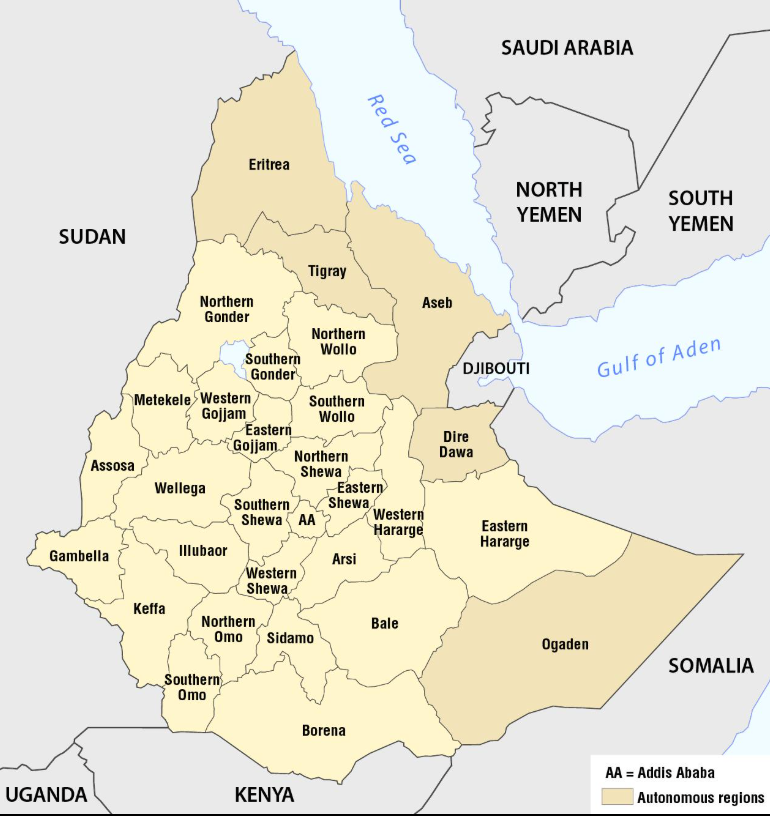
Ethiopia’s 1987 constitutional and administrative framework established autonomous regions, including Assab. A 1988 U.S. State Department report identified Assab as one of Ethiopia’s five autonomous zones. Under that framework, Assab had a distinct legal and administrative status within Ethiopia; it was not part of the Eritrean administrative region.
This raises a fundamental constitutional question: By what legal authority could the Transitional Government of Ethiopia, operating under the 1991 Transitional Period Charter, surrender Assab to Eritrea?
That Charter was an interim governing framework, not a constitution adopted by an elected constituent assembly. If Assab was an autonomous region within Ethiopia under the existing constitutional order, could the transitional government lawfully relinquish its sovereignty without clear constitutional authority and a legally valid process authorizing such a decision?
The issue is not simply whether Ethiopia recognized Eritrea’s independence. It is whether that recognition, or any related transitional arrangement, legally authorized the transfer of Assab’s status and territory. That question demands a clear answer grounded in the relevant constitutional provisions, legal instruments, and decisions made during the transition.
If the transitional government lacked the legal authority to relinquish Assab, and no subsequent legally valid instrument transferred sovereignty over the territory, the situation could raise the grave question of unlawful territorial acquisition (forcible annexation) and the continued denial of Ethiopia’s sovereign rights. Then, the legal basis of Eritrea’s claim to the port must be seriously questioned. Indeed, Ethiopia would have grounds to challenge the legitimacy of the arrangements that placed Assab under Eritrean control and demand a lawful and peaceful resolution of the dispute.
In light of these and similar questions, if it can be shown Eritrea’s sovereignty over Assab was acquired by means that do not conform with the legal and constitutional requirements, Ethiopia shall have the sovereign right to reclaim its annexed territory by any means necessary.