
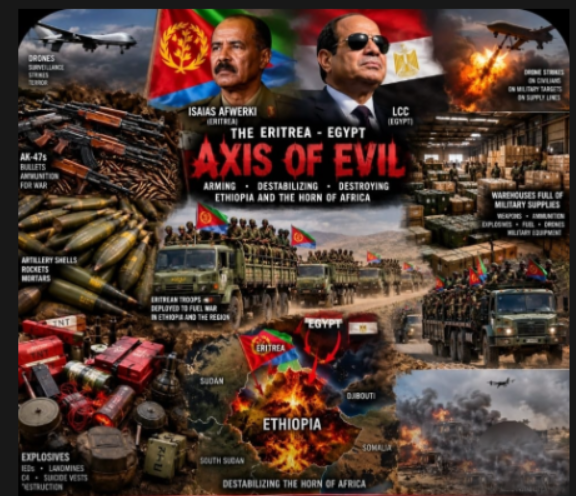
THE CAIRO–ASMARA AXIS OF EVIL: ISAIAS AFEWERKI’S TRUE CONFESSION
“… There are many historical reasons why Egypt has supported Eritrea. The reason why Eritrea supported Egypt and Egypt supported Eritrea is to deprive Ethiopia of peace or to give it work [create hardship]. It is not because they [Egypt] think Eritrea will be a peaceful, sovereign or independent country. The main agenda and strategic reason is Nile waters. Egyptians have a strong belief that unless the upstream countries through which the Nile flows are in a state of perpetual turmoil and have no peace, they cannot control the Nile waters. Why Egyptian politicians have this outlook is a question that has its own history…” (Isaias Afewerki, Secretary-General of the Provisional Government of Eritrea — at a press conference ca. 1991–1993.)
What Afewerki’s confession means —and why it matters
Simply put, Afewerki’s advances three brazen claims:
- Egypt and Eritrea have historically supported one another with the shared objective of depriving Ethiopia of peace and creating havoc for the Ethiopian state.
- The strategic motivation behind the Egypt–Eritrea axis is to secure Egyptian dominance over the Nile waters by constraining Ethiopia’s ability to exercise its interests, particularly its national riverine development projects on the Abbay (“Nile”) River.
- Instability, division, and perpetual conflict in the upstream Nile Basin countries are integral to the strategic thinking and practice of Egyptian leaders.
Lately, it has become crystal clear that Afewerki believes his regime survivability– the ultimate prize — depends on Ethiopia’s disunity, instability, insecurity, and instability.
Viewed against the broader history of the past four decades, Afewerki’s statement raises serious questions about his regime’s enduring alignment — unholy matrimony — with Egypt and their joint coordination and die-hard determination to destabilize Ethiopia and permanently cripple her strategic and developmental aspirations.
The idea of Ethiopia controlled by Egypt and Eritrea together, forever trapped in a web of conflict and war, is not something that is accidentally conceived through competition among regional neighbors. It is a wicked design deliberately concocted by the Egyptian and the Eritrean regimes with the aim of disintegrating Ethiopia piece by piece through endless civil wars. It is a devilish game of conspiracy and intrigues, deception, and manipulations with a single objective: To indulge the the inane and insane fantasies of the Egyptian regime to achieve a monopoly over the waters of the Nile as wannabe colonial overlords.
The Current Crisis: Historical Context Meets Present Security Threats
Afewerki’s statement provides a revealing lens through which to examine the present crisis and assess the factors that have pushed Ethiopia and Eritrea to the brink of military confrontation today.
War and rumors of war between Ethiopia and Eritrea are no longer a matter of media speculation. The facts are incontrovertible. The Eritrean regime has repeatedly conducted military raids and invasions within Ethiopia. That regime has provided backing for terrorists in Ethiopia who have assumed the guise of “freedom fighters.” All these actions have led to a further escalation in the ongoing diplomatic conflict. Behind all this stands Egypt engaged in vicarious aggression.
Although the Eritrean regime has denied its invasion of Ethiopian territory, there are numerous credible sources that have revealed facts of Eritrean troops within Ethiopia. By geolocating video clips, the investigative agency Misbar has identified the locations of Eritrean troops along highway A2 inside Ethiopia in the areas of Idaga Hamus and Adigrat near the Eritrean border. The Associated Press has made similar reports.
There have been sightings of Eritrean troops crossing the border at Zalambessa, the primary crossing point along the Ethiopian and Eritrean border. The Armed Conflict Location and Event Project (ACLED) has also identified the destruction of Eritrean targets by Ethiopian drones. There have been sightings of Eritrean troops making military incursions into Ethiopian territories up to distances of 60 kilometers from the border. ACLED has identified signs of support provided by Eritreans to the TPLF and other terrorist insurgents, and provided support to form an alliance of local armed groups to remove the democratically elected government of Ethiopia.
In addition to these attacks, Ethiopia has formally accused Eritrea of supporting terrorist insurgent groups that are fighting to overthrow the Ethiopian government. Gideon Timoteos, Ethiopia’s Foreign Minister, and Army Chief of Staff Field Marshall Berhanu Jula have accused the Eritrean regime of occupying Ethiopian territories and funding armed insurgent groups in Ethiopia. These accusations have been made through proper diplomatic and public channels and reported in international media outlets.
“Give Ethiopia Work”: The hand that rocks the Eritrean cradle
The most illuminating and thought-provoking statement in Afewerki’s description of the formation of the Egypto-Eritrean alliance is their absolute determination to “Give Ethiopia work.” This statement has strategic implications and becomes particularly significant because Afwerki himself ties it to making Ethiopia live without peace and in turmoil, and refers to the waters of the Nile as a strategic motive for the Egyptian strategy.
The obvious interpretation of “giving Ethiopia work” is to make Ethiopia suffer from continuous security problems. Instead of letting the government of Ethiopia focus on its economic and social development, Egypt and Eritrea will undertake an endless campaign of destabilization that will keep Ethiopia busy with internal conflicts, terrorism, and political instability.
To deal with the endless security problems, Ethiopia will need to spend a lot of money on military acquisitions and security activities, thus spending less money on other development projects. So the idea of the strategy “to give Ethiopia work” is to put Ethiopia into an endless cycle of continuous security and military spending. The more money Ethiopia will spend on solving the problem of instability, the less money it will have for development.
Afewerki’s words also point to weakening of the Ethiopian state by contriving and perpetuating circumstances that incapacitate its rule, diminish its institutional strength, and undermine its national unity. This includes sustained support for insurgencies and internal conflicts that could weaken the Ethiopian government’s relations with its citizens, polarize the political landscape of Ethiopia, disrupt its administration, and undermine trust in national institutions. Weakening the state is much more than just causing temporary damage to the administrative capacity of the Ethiopian government. It goes to the heart of eviscerating Ethiopia’s capacity to pursue its strategic national agendas.
It is clear from Afewerki’s statements that Ethiopia’s economic development and strategic projects are in the cross hairs of the Cairo-Asmara axis. Afewerki makes it clear that the Nile river is the main strategic objective in Egypt’s relations with Eritrea. It is an article of faith for the Egyptian regime that countries upstream the river should experience chaos in order for Egypt to be able to retain control over the waters of the river.
Internal unity and cohesion are vital for Ethiopia’s future. When Egypt and Eritrea foment destabilization, Ethiopia’s capacity to fund, build, protect, and manage its major strategic projects diminishes significantly. If Ethiopia were a stable and economically growing country, it would enjoy more diplomatic bargaining power, military capability, and clout in the Horn of Africa region. An Ethiopia constantly having to handle internal crises would have fewer options for acting in the region and projecting itself beyond its borders. “Making Ethiopia work” in a larger geopolitical strategy means tying down Ethiopia internally so that it cannot develop into a strong regional player.
What is most remarkable about Afewerki’s phrase is the contrast between the triumph over one’s enemy in battle and the infliction of a debilitating disease that makes the enemy survive but in a state of perpetual debilitation and weakness, one that keeps the opponent not thriving but on the edge of survival. Afewerki knows that conventional wars are risky and unpredictable.
In May 1998, Afewerki attacked Ethiopia’s territory of Badme using tanks and artillery. The international court later found out that the Eritrean attack breached international law and thus sparked the whole war. If Ethiopia had been governed by a real patriot government, instead of a comprador regime that was working for the benefit of Eritrea, this war would not have taken place, and Ethiopia would not be going through problems that it is experiencing with Eritrea now.
For Egypt and Eritrea the objective is to keep Ethiopia fighting on several fronts not against foreign enemies but against itself — ethnic, religious, communal, regional conflict– and thereby exhaust the country’s strength and distract it from any other productive activities. So, it is a calculated strategy of exhaustion of Ethiopia through the expenditure of its energy and resources.
The fact that Eritrea is doing Egypt’s dirty work by deliberately inciting and helping the initiation of armed conflict in Ethiopia not only means that it is a threat to Ethiopia’s security and sovereignty but also a threat to peace in the region. Therefore, “Give Ethiopia Work” is a very important message by Afewerki for it can easily be adapted to “give Somalia, Djibouti, South Sudan, Sudan, Kenya…work” if the Eritrean regime feels threatened.
Afewerki’s confession foreshadows the current regional threat
On October 17, U.S. Secretary of State Marco Rubio warned that the concentration of troops on both sides of the Ethiopia–Eritrea border could turn the confrontation into a broader war involving other countries. He acknowledged the security challenge posed by armed separatist attacks inside Ethiopia, referred to drone attacks against the Ethiopian capital, and urged Ethiopia to respond wisely and proportionately to avoid a wider conflict. His remarks underscore the fact that the crisis is no longer a bilateral dispute that can be treated in isolation.
The fundamental strategic question is whether Eritrea and Egypt are deliberately engineering and sustaining Ethiopia’s security crisis. Egypt’s longstanding dispute with Ethiopia over the GERD coincides with Eritrea’s deteriorating relations with Ethiopia over security concerns and Ethiopia’s pursuit of Red Sea access.
If Afewerki’s assertion that Eritrea’s alliance with Egypt is intended to contain Ethiopia geopolitically and impede its economic development reflects the alliance’s underlying strategy—by providing armed groups with funding, weapons, sanctuary, political support, and operational assistance—then a critical question arises: What strategic, diplomatic, economic, and legal options are available to Ethiopia to counter these threats, safeguard its sovereignty, and secure its long-term national interests?
The fundamental danger, as Secretary Rubio indicated, is that Ethiopia’s internal insecurity engineered by Egypt and Eritrea could become a regional threat. Every cross-border incursion into Ethiopia by Eritrea, every support by Eritrea and Egypt for armed rebellion, and every escalation diverts national resources from regional development and weakens the prospects for stability across the Horn.
Afeworki’s words provide clear proof that Egypt and Eritrea are hellbent on destabilizing Ethiopia. But the consequences would extend far beyond Ethiopia’s domestic politics: they would threaten regional peace, the security of the Red Sea corridor, and the possibility of resolving Nile disputes through negotiation rather than coercion.
Ethiopia should defend its sovereignty by negotiation or self-defense
In light of repeated threats and aggression against its sovereignty, territorial integrity, and security, one cannot expect Ethiopia to stand idly by and see itself destabilized with the collaboration of Egypt and Eritrea. Ethiopia has an unquestioned sovereign right to protect its people, national interests, and future. Ethiopia has always preferred dialogue to confrontation. Ethiopia also knows that, in the face of an implacable and sworn enemy, it must prepare for war even as it offers an olive branch. Ethiopia has strengthened its defensive capabilities, and neither Eritrea nor Egypt should mistake Ethiopia’s deep commitment to peace for weakness or an open invitation to attack with impunity.
If Eritrea refuses dialogue, as it has demonstrated in many ways, and continues to act in a hostile manner that precludes a peaceful option, then Ethiopia cannot be expected to stand helpless and defenseless.
Ethiopia is a nation that seeks peace with its neighbors and others, near and far. A nation that seeks peace should not be regarded as one that lacks the power of self-defense.
Afewerki’s regime and its Egyptian patrons must understand the following message with crystal clarity: Ethiopia seeks peace, but it will not surrender its sovereignty to secure it. Ethiopia’s preferred path is dialogue and diplomacy, but not at the heavy price of its territorial integrity, sovereignty, unity, and national dignity. Eritrea and Egypt should not mistake Ethiopia’s preference for peaceful coexistence for a lack of steely resolve to defend itself.
Despite Ethiopia’s efforts to establish peaceful relations, it will never abandon its right to defend its sovereignty. If peaceful negotiations are unavailable or fail, and an immediate danger to Ethiopia’s sovereignty and territorial integrity exists, leaving no other lawful means of addressing it, Ethiopia’s act of self-defense cannot be considered an act of aggression.
Both Egypt and Eritrea have adopted a strategy of direct and indirect aggression on Ethiopia by way of regional cooperation and supporting militant factions as well as trying to ensure that Ethiopia does not have secure access to the Red Sea for their own strategic advantage.
Considering the foregoing facts, does the international law provide for a right for Ethiopia to practice the doctrine of anticipatory self-defense in response to such aggression thereby creating a security buffer zone within Eritrea to prevent further incursions?
Yes. End of Story. Better yet, stay tuned.
Egyptian client state in Eritrea
One of the main issues that comes out of this long-term strategic alliance is whether the Afewerki government operates as a client state for Egypt. Indeed, in this regard, there is no question about the fact that Afewerki acts as a proxy of Cairo that aims to diminish the influence and power of Ethiopia in the region. The irony is in the fact that this Eritrean government, which is used by Egypt as a proxy, itself becomes a proxy of its proxy in the form of the TPLF, which is used to destabilize Ethiopia and the region. It is odd to see how one political entity, operating as a proxy for one external power, outsources a good part of its responsibilities as a proxy to another political actor.
The irony is even more striking: A state sponsor of terrorism outsourcing its proxy operations to another proxy, effectively subcontracting destabilization through a chain of terrorist networks. A state sponsor of terrorism itself becomes a terrorist organization!
Egypt’s opposition to GERD is one of the main reasons for the conflict between Egypt and Ethiopia since Egypt sees the construction of the dam as Ethiopia’s sovereign development initiative. The initiative of Ethiopia to acquire Red Sea access contributed to increased rivalry in the region; Egypt, Eritrea, and Somalia became partners to some extent.
In October 2024, the Egyptian-Eritrean-Somali Summit reinforced the cooperation of these countries in issues of regional security and marine affairs. In the Alamein Joint Declaration (signed on October 4, 2026, Egypt, Eritrea, and Sudan), the parties express their hostility towards Ethiopia by opposing any unilateral measures affecting the use of the water of Egypt and Sudan in the Nile River and asserting that Red Sea governance belongs exclusively to the littoral states. However, Somalia has stated it is neutral in the escalating tension in the Horn of Africa, declaring that it is not part of the rivalry involving Ethiopia, Egypt, and Eritrea.
The fundamental question here is whether the relationship between Eritrea and Egypt amounts to a case of the patron-client relationship where Eritrea is a sovereign entity but is increasingly becoming obsessed with the strategic interests of Egypt.
It is self-evident that Eritrea continues to make its diplomatic and military efforts towards realizing the strategic interests of Egypt, depending on Egypt politically, militarily and diplomatically; it has become an Egyptian client state. It is evident Egypt can easily use the influence over the Eritrean regime to pressure Ethiopia along its northern border without necessarily engaging Ethiopia in confrontation. Indeed, Eritrea has become more than an Egyptian client state; it acts as a proxy force for protecting Egyptian interests in Ethiopia.
Food for thought for the Eritrean regime
An African proverb teaches, “If you are digging a pit for your enemy, don’t make it too deep, for you may fall into it.”
Suppose Ethiopia begins supporting and materially aiding disruptive elements inside and outside of Eritrea using the exact same methods and at the same or higher level than Eritrea and Egypt are using to destabilize Ethiopia. After all, what is sauce for the goose should be good enough for the gander. Eritrea cannot complain if the very same tactic it uses to destabilize Ethiopia is used against itself. This tactic of destabilization can come back to bite Eritrea in the behind and they can very easily find themselves trapped in the exact same web of destabilization that they have unleashed against Ethiopia.
As old as politics is, the lesson is just as timeless. What goes around comes around, and those who lay traps for others might end up getting caught in it. Those who play with fire get burned. Call it blowback, poetic justice, or karma, the truth remains the same: A government that uses destabilization in order to conduct its foreign policy will one day reap what it sowed.
The Eritrean regime should heed the words of Julius Caesar: “War gives victors the right to impose any condition they please upon the vanquished.” Vae Victis (“Woe to the vanquished”).
Eritrea’s regime would also do well to heed the biblical warning: “God gave Noah the rainbow sign: no more water, the fire next time.”
The Eritrean regime should pause and gaze upon the rainbow sign and choose dialogue, give-and-take, and peace. Or face the fire next time—a fire that, once unleashed, will be impossible to contain, consuming the Eritrean regime and leaving Eritrea transformed beyond recognition.
A word to the wise.